
How we make puzzles with exactly one answer
A good logic puzzle has one answer, and you can reach it by thinking. If two answers fit, the last step is a coin toss. If the only way forward is a guess, it’s luck dressed up as logic.
All three Fibbersons dailies are built to avoid both. Lie of Sight, Rex’s Fetch and Lacey’s Web each come out of a maker that draws lots of puzzles, and a checker that throws away every one it can’t prove. Here is how that works for each game, without giving any day away.
The idea all three share
Each puzzle starts as a draft from a seeded random maker. “Seeded” means the same starting number always gives the same puzzle. For Rex’s Fetch and Lacey’s Web the date is that number, so the date decides the day’s yard and web. Lie of Sight’s cases are made ahead and stored, a week at a time. Either way, everyone in the world gets the same puzzle that day.
Then a checker looks at the draft with no idea what the answer is meant to be. It works from what the player sees, and only the player’s own rules. If it finds more than one answer, or none, or an answer you could only reach by guessing, the draft goes in the bin and the maker draws another.
Because the date decides a yard or a web, our server can rebuild any day’s yard or web by itself. That’s how a finished time on those two is checked: the server makes the day’s puzzle again and checks your answer against it, so no list of their answers sits anywhere to be leaked.
Lie of Sight: one liar, and only one
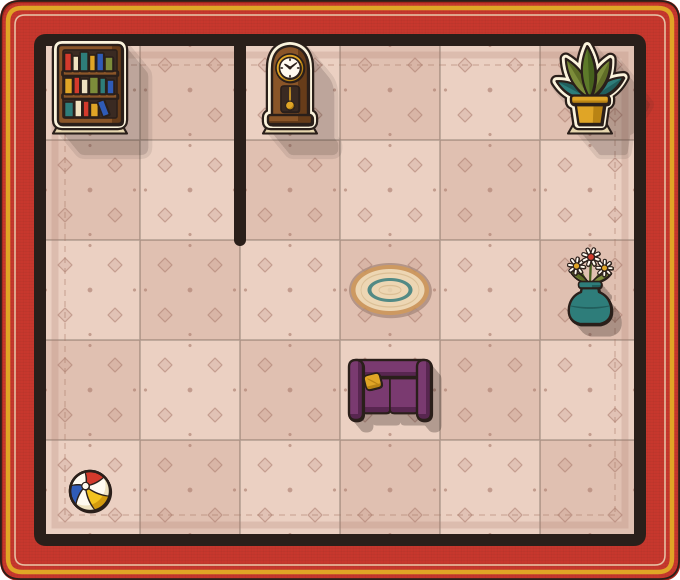
A Lie of Sight case is a room seen from above. Each member of the family says one to three things about what they could see from where they stood (“I saw the clock”, “I didn’t see Grandma”). Exactly one of them is lying.
Puzzles about who’s telling the truth are much older than this. The best known are knights and knaves puzzles, named by the logician Raymond Smullyan in 1978, where knights always tell the truth and knaves always lie. Our knights and knaves guide has some to try, and how Lie of Sight’s picture version differs.
Making a case. The rooms are drawn by hand: the walls, the furniture and the tall and low things that block a view. For each day, the maker drafts cases: it takes a room, shifts a few pieces around, puts the family somewhere in it and chooses who will lie. Then it writes cards from what each person really could or couldn’t see from there. A card is only ever about something that person could see from somewhere in the room, so no claim is nonsense on its face.
Checking it. The checker ignores where the maker put everyone. It tries every way the family could stand in the room, square by square (anyone the case shows already standing stays put), and for each one it checks which cards are true. It keeps the case only if one person’s card is the false one in every arrangement that leaves exactly one card false. That’s what “fair” means in the code: exactly one person can be the liar.
There’s a second test. The liar’s card has to be one that could be true on its own. If it couldn’t, you’d spot the liar from a single card and never need the room. Instead you have to put their story beside someone else’s and see that the two can’t both hold. How many other stories you need for that is part of a case’s grade, and every daily is kept in the same narrow band of grades.
No shortcuts. A puzzle can be fair and still be easy to guess. Maybe the liar always has the longest card, or the most ✗ marks. So every case is tested against 37 one-glance shortcuts like “the one with the most ✗”, “the odd one out” and “the one nobody says they saw”. Each week’s cases are picked so that no shortcut finds the liar more than 40% of the time, over the week and over the last four weeks, and only rarely for certain. Ten more shortcuts are held back. They are held to much the same limits, but the picker never aims at them, so they check that it isn’t just dodging the first list.
A few more rules keep a week from getting predictable: no liar two days running, nobody lies more than twice in seven days, and a room waits at least ten days before it comes back in the same shape (four in a different one).
Made ahead, then locked. Lie of Sight’s dailies are made weeks ahead and stored. A day before a date can start anywhere in the world, it’s locked and never made again. If a day looks wrong before then, it can be thrown out and rebuilt.
Does it work? In the seven days to October 8, 2026, 218 of the 228 answers given on the daily case were right, about 96%. The cases are hard enough to make you think, and never a trick.
If you’d like to see the reasoning step by step, how to spot the liar walks through a case square by square.
Rex’s Fetch: exactly one route
In Rex’s Fetch you lead Rex the dog through every open square of the yard, one step at a time, up, down, left or right, without crossing his own trail, and he finishes on the ball. Puzzle people call that a Hamiltonian path, the same idea as the chess knight’s tour, where a knight lands on every square of the board once.
Making a yard. From the date, the maker draws a yard: its size, a few bushes, flower beds and a birdbath to block the way (never four in a square, never on Rex’s starting spot), Rex on the bottom row by the porch, and the ball at least two rows up and not right next to him.
Checking it. A route counter then walks every trail Rex could take, and stops as soon as it has found two. The yard is kept only if the count is exactly one. To get through big yards quickly it uses a few checks that never cut off a real route, and they’re the same checks a good player makes:
- The checkerboard. Color the yard like a chessboard. Every step goes from one color to the other, so the number of light and dark squares, and the colors of Rex’s square and the ball’s, must fit. Some yards fail this before anyone takes a step.
- Dead ends. Every square still to visit needs a way in and a way out, except the ball, which needs only a way in. A square left with one way in, which isn’t the ball, means the trail has gone wrong.
- Forced steps. If a square next to Rex has only one other way out, he has to go there now, or it will be cut off.
- One piece. The squares still to visit must all hang together. If the trail splits them in two, Rex can’t reach both halves.
Picking the day’s yard. Since October 23, 2026, the maker draws many yards for each day, each with one route, and grades them. The grader walks the route like a careful player. A step with only one sensible choice costs little. A real choice costs more, and each wrong turn costs more again, by how far you could follow it before you’d see it fails. The day’s yard is the one closest to that day’s target. At the moment Monday to Saturday share one level (6 × 6), and Sunday’s yard is 7 × 7.
Each night we look at how players did, organic players only, and if a level was too hard or too easy, the level for days a few days ahead moves one step. Never a day anyone could already have open.
Our tests check that every yard for the next 400 days, and two years of the harder days, has exactly one route. There’s more on solving them in our guide to path puzzles.
Lacey’s Web: one web, mended by logic alone
In Lacey’s Web, Grandma swept a spider’s web and only the knots are left, each showing how many threads it held. You spin the threads back so every knot has its number and all the threads make one web.
It’s a cousin of Hashi (Hashiwokakero), the bridge-building puzzle from Nikoli, the Japanese puzzle publisher.
Making a web. The maker drops threads at random on the web’s lines (the spokes and the rings), keeps the draw only if every knot holds at least one thread and they are all joined, and then reads each knot’s number off it.
Checking it. Here the checker is stricter. It doesn’t just count answers. It gets the numbers alone and has to mend the whole web using only the rules a player has:
- If a knot’s open lines are exactly what it still needs, spin them all.
- If a knot is full, ✕ the rest of its lines.
- Keep it one web: a line whose ✕ would cut part of the web off must be spun, and a thread that would close off a finished group must be ✕.
- A short “try it”: suppose a line is a thread, follow rules 1 and 2 for a few rounds, and if a knot can’t get its number, the line is the other way. Two to five rounds at most, by level: a chain you can follow in your head.
If those rules mend every line from the numbers alone, then every step was forced, so there’s only one answer, and you can reach it without guessing. Our tests also count each web’s answers a second way, with a counter that uses none of the rules, as a check on the checker.
Some knots on the daily web show “?” instead of their number. A web with “?” knots is kept only if the rules still mend it with those numbers unknown. For a worked example, see our Lacey’s Web guide.
What this means when you’re stuck
If you’re stuck on any of the three, there is always a next step you can prove from what’s on the screen. You never need to guess. In Lie of Sight, a wrong accusation costs you points. In Rex’s Fetch and Lacey’s Web, backing up never counts against you.
So when a puzzle stops moving, look for the forced move: the person with the fewest places to stand, the corner square with two ways out, the knot with exactly as many lines as it needs. It’s there.
Play today’s case · Play Rex’s Fetch · Play Lacey’s Web · How to play all three
Other small daily logic games we like
A few more dailies from independent makers, for when you’ve finished ours:
- Clues by Sam: work out who’s innocent and who’s a criminal from the clues, with no guessing needed.
- Cluewright: daily logic and word puzzles with calibrated levels and no blind guessing.
- Alibi: put every suspect and piece of evidence back in their room.
- Meikyu: a daily dungeon puzzle: deduce a five-slot lineup in six tries.
- Redacted: a daily case file with five words blacked out. Piece together what happened.
Questions people ask
Can a Fibbersons puzzle ever have two answers?
No. Every daily is checked by a computer before anyone plays it. Lie of Sight keeps a case only if one person can be the liar, Rex’s Fetch only if the yard has one route, and Lacey’s Web only if logic alone mends the whole web.
Do I ever have to guess?
No. Every daily can be solved by reasoning from what’s on the board. In Lacey’s Web that’s how each web is checked: a solver mends it with the player’s own rules, and a web it can’t finish that way is thrown out.
Is the daily puzzle the same for everyone?
Yes. Everyone gets the same case, yard and web that day, new at midnight in your own time zone.
Are the puzzles made by a computer?
Lie of Sight’s rooms and family are drawn by hand, and a program builds each day’s case in them and checks it. Rex’s yards and Lacey’s webs are made and checked by a program from the date.
Do the puzzles get harder through the week?
Not anymore. Monday to Saturday are one level, and Sunday’s yard and web are bigger. The level moves a step only when players’ times show it was too easy or too hard.