
Deduction puzzles
A deduction puzzle gives you a handful of clues and asks you to reason your way to the one answer they allow: who did it, who sits where, who is lying. There is no guessing and no trick. Each clue rules something out until only one possibility is left. Below are the main kinds, a five-step method, and four puzzles to try, easy to hard, answers hidden.
The main kinds of deduction puzzle
They share one rule: everything you need is in the clues. What changes is what the clues are about.
- Grid puzzles. Match people to things, places or times from a list of clues, crossing off on a grid what can’t be true. The best known is the zebra puzzle. Murdle and Murdoku add a crime to the grid: see games like Murdle and games like Murdoku.
- Truth-teller and liar puzzles. Some people always tell the truth and some always lie, and you work out who is which from what they say. The classic is knights and knaves; who is lying riddles tell you how many are lying.
- Whodunits. A short mystery with a few suspects and one culprit, solved from alibis and evidence rather than a hunch. Try three small ones on mystery logic puzzles.
- Seating and order puzzles. Who sits where at a table, who lives on which floor, who finished first. The clues are about position: next to, left of, above.
- Line-of-sight puzzles. Who could see what from where in a room. Each statement becomes a set of squares where that person could have stood. This is the kind Lie of Sight makes: see spatial reasoning puzzles and find the liar puzzles.
How to solve a deduction puzzle
- List what is possible.For each person, write down every place or thing they could have. On paper, a small grid with a row per person does it.
- Start with the most constrained.Find the person or thing the clues pin down hardest, often one with two or three clues about it, and settle that first.
- Eliminate, then look again.Each fact you settle rules out options for everyone else. When only one option is left for someone, write it in and go back over the clues.
- Stuck? Test a “what if”.Suppose one of the last two options is true and follow it. If it leads to a clash with a clue, the other option is the answer.
- Check every clue.Read each clue once more against your answer. In a well-made puzzle every one holds, and every one was needed.
Liar puzzles add one more move: suppose someone is the liar, treat the rest as true, and see if it holds together. There is a worked example, square by square, in how to spot the liar.
Four deduction puzzles for adults, easy to hard
Each is new, written for this page, and checked by trying every possible answer: exactly one fits all the clues, and every clue is needed to get there. You need nothing but the clues.
Puzzle 1: The bake sale (easy)
A grid puzzle
Mia, Noah and Owen each brought one thing to the bake sale: brownies, cookies or muffins.
- Mia didn’t bring the muffins.
- Noah brought neither the cookies nor the muffins.
Who brought what?
Show the answer
Mia brought the cookies, Noah the brownies and Owen the muffins.
Start with whoever the clues pin down most. Noah brought neither the cookies nor the muffins, so he brought the brownies.
That leaves the cookies and the muffins for Mia and Owen. Mia didn’t bring the muffins, so she brought the cookies, and Owen brought the muffins.
Puzzle 2: Three floors, three coats (medium)
A grid puzzle with two lists
Ruth, Seth and Vera live in a small building, one on each floor: 1, 2 and 3, with floor 1 at the bottom. Each has one winter coat: red, blue or green.
- Whoever has the red coat lives on the floor just above Seth.
- Vera lives higher up than Ruth.
- The green coat belongs to whoever lives on floor 1.
- Ruth’s coat isn’t green.
Who lives on which floor, and whose coat is which?
Show the answer
Seth lives on floor 1 with the green coat, Ruth on floor 2 with the red, and Vera on floor 3 with the blue.
Ruth’s coat isn’t green, and the green coat is on floor 1, so Ruth isn’t on floor 1. Vera lives higher than Ruth, so Vera isn’t on floor 1 either. That leaves Seth on floor 1, with the green coat.
The red coat is just above Seth: on floor 2. Ruth is below Vera, so Ruth is on floor 2 with the red coat, and Vera is on floor 3 with the blue one.
Puzzle 3: Four seats at the movies (medium-hard)
A seating puzzle
Yara, Vic, Wes and Xia sit in a row of four seats, numbered 1 to 4 from left to right.
- Yara sits at one end of the row.
- Vic sits right next to Wes.
- Xia sits somewhere to the right of Wes.
- Yara doesn’t sit next to Vic.
- Yara sits somewhere to the left of Xia.
Who sits in which seat?
Show the answer
From left to right: Yara, Wes, Vic and Xia.
Yara sits at an end, and someone sits to her right (Xia), so she isn’t in seat 4. She is in seat 1.
Vic isn’t next to Yara, so Vic isn’t in seat 2. Wes is next to Vic and has Xia somewhere to his right, so Wes isn’t in seat 4. Try Vic in seat 4: Wes would be in seat 3, with no seat to his right for Xia. So Vic is in seat 3, Wes is beside him in seat 2, and Xia is in seat 4.
Puzzle 4: Who took the last cookie? (hard)
A whodunit
Isla, Jude, Kara and Leo were each in a different place all afternoon: the kitchen, the garden, the attic or the hall. Each had one thing with them: a book, a kite, a mug or a phone. The cookie jar is in the kitchen, so whoever was in the kitchen took the last cookie.
- Leo was in the kitchen or the hall.
- Jude was in the attic or the hall.
- Kara was in the kitchen or the attic.
- Isla had the kite or the phone.
- The phone was in the kitchen or the hall.
- The mug was in the kitchen or the garden.
- If Jude had the phone, then Kara was in the hall.
Who took the last cookie?
Show the answer
Kara took it: she was in the kitchen, with the mug.
Leo, Jude and Kara could each only be in the kitchen, the attic or the hall, so between them they fill those three places, and Isla was in the garden. The phone wasn’t in the garden, so Isla had the kite. The mug wasn’t in the garden either, so it was in the kitchen, and the phone, in the kitchen or the hall, was in the hall.
That still leaves two ways to fill the house, so try one. Suppose Leo was in the kitchen. Then Kara was in the attic and Jude in the hall, with the phone. But if Jude had the phone, Kara was in the hall, and she isn’t: the guess breaks.
So Leo was in the hall with the phone, Jude in the attic with the book, and Kara in the kitchen with the mug. Kara took the last cookie.
A new deduction puzzle every day: Lie of Sight
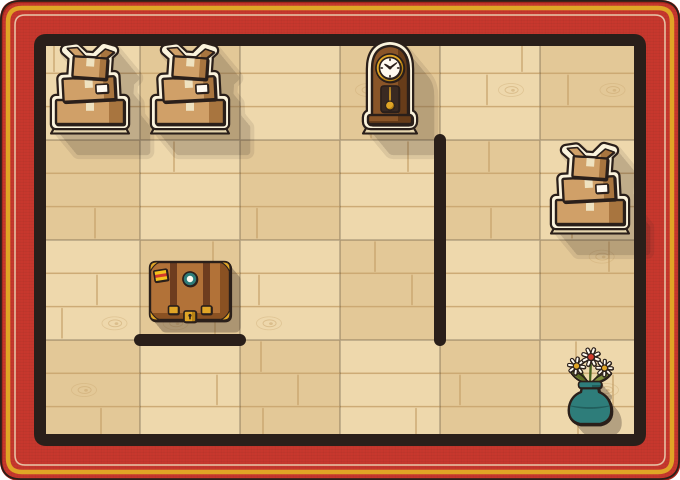
Lie of Sight is a deduction puzzle you play, not read. Each case is a room seen from above, and the Fibberson family each say what they saw from where they stood: “I saw the clock”, “I didn’t see Grandma”. Exactly one of them is lying. Each of them sees by one rule (Dad his whole row and column, Grandma only two squares around her, Rex the dog by smell), so every statement narrows down where that person could have stood. You move them around the room until every story but one can be true at once, and the one that never fits is the liar’s.
It works like the puzzles above. Start with whoever has the fewest places to stand, eliminate, and test a “what if” when you’re down to two. Every case has exactly one liar you can prove, with no luck involved. There is a new one every day at midnight, your time, the same for everyone, so you can compare with friends without giving it away.
More on the daily: a free daily logic puzzle and logic puzzles for adults.
More deduction puzzles online
If you want a deduction puzzle every day, there are several to choose from, most of them free in a browser. They are compared side by side in daily mystery games, games like Clues by Sam and games like Murdle.
Questions people ask
What is a deduction puzzle?
A puzzle you solve by reasoning from the clues you are given, with no guessing and no outside knowledge. Each clue rules something out, and a well-made one has exactly one answer that fits every clue.
What is the difference between deduction and logic puzzles?
Most logic puzzles are deduction puzzles. “Logic puzzle” also covers number puzzles like sudoku, while “deduction puzzle” usually means people, places and clues: who did what, where, and who is telling the truth.
Is a deduction puzzle the same as a riddle?
Not quite. A riddle often has a twist or a play on words you have to spot. A deduction puzzle has no trick: everything you need is in the clues, and you can prove the answer step by step.
Is there a deduction puzzle every day?
Yes. Lie of Sight has a new one every day, free in the browser: a family each say what they saw in a room, exactly one of them is lying, and you work out who.
Is Lie of Sight free?
Yes. The daily case is free every day, plus 28 free cases: 3 practice, 15 Case Files and 10 Tricky Cases. A one-time unlock adds more, with no subscription and no ads.
Ready for today’s case?
A new case every day. Free, with no sign-up to start.